

Love is patient; love is kind; love is not envious or boastful or arrogant or rude. It does not insist on its own way; it is not irritable or resentful; it does not rejoice in wrongdoing.(1Cor 13:4-7)


Homily
Manna or the Bread of Life - Tuesday, April 21, 2026
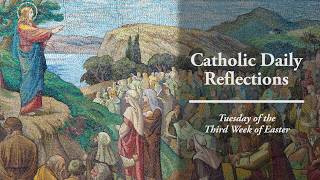
The crowd said to Jesus: “What sign can you do, that we may see and believe in you? What can you do? Our ancestors ate manna in the desert, as it is written: ‘He gave them bread from heaven to eat.’” John 6:30–31
Today’s Gospel begins the beautiful Bread of Life Discourse, which we read at Mass for the rest of the week. In this discourse, we read the conversation Jesus had with some of the crowd who, the previous day, were among the more than 5,000 who were miraculously fed by the multiplication of the loaves and fishes. The conversation begins with the crowd’s search for physical sustenance and gradually unfolds into a revelation of a deeper, spiritual nourishment as Jesus points them to the “food that endures for eternal life” (John 6:27).
After Moses led the Israelites out of Egypt and they wandered in the desert for forty years on their way to the Promised Land, God provided them with manna as “bread from heaven” (cf. Exodus 16:4–34). About 820 years after the Israelites entered the Promised Land and established their kingdom, Jerusalem fell to the Babylonians in 586 B.C. During this time, the prophet Jeremiah is said to have hidden the Ark of the Covenant, which contained a pot of manna...before the Jews were taken into exile (cf. 2 Maccabees 2:5–8). This hidden manna held symbolic significance, and tradition suggests there was a belief that it would miraculously reappear at Passover when the Messiah came, beginning the dawn of the last days and a new era of divine fulfillment.
Some traditions suggest that there was an expectation of the hidden manna’s return, leading the crowd to wonder if Jesus would reveal such treasures—true spiritual gifts that would confirm that He was the long-awaited Messiah...uncovering the old Ark but by revealing Himself as the new Manna: “...my Father gives you the true bread from heaven. For the bread of God is that which comes down from heaven and gives life to the world” (John 6:32–33).
When Jesus revealed this, the people asked Him, “Sir, give us this bread always” (John 6:34). Unfortunately, the people still did not understand... Therefore, Jesus clearly exclaims, “I am the bread of life; whoever comes to me will never hunger, and whoever believes in me will never thirst” (John 6:35). With that, Jesus begins to teach about the Eucharist, a teaching that would find its fulfillment at the Last Supper, where He offered Himself as true food and drink for the life of the world.
As we begin reading the Bread of Life Discourse, we are invited into the greatest mystery of our faith. As a divine mystery—a mysterium fidei—the Eucharist is not something we can figure out by study alone. The Eucharist is God’s Presence into which we are invited to enter, and Jesus must teach us the way. The Eucharist is only understood properly through prayer—a prayer in which God reveals His hidden presence to us.
Reflect today on your understanding of the Eucharist. Only the spiritual Gift of Understanding will enable us to more fully comprehend this most precious Gift. As we read through the Bread of Life Discourse this week, make an effort to pray over the words. Ask for enlightenment. Like the members of the crowd who conversed with Jesus in today’s Gospel, commit yourself to participate in their discussion. Seek to understand so that you will believe and share in the abundant blessings given to those who partake of the Bread of Life.
Bread of Life, You are the true food from Heaven, You are sustenance for my weary soul. As we reflect on Your beautiful and mysterious teaching of the Eucharist, please help me to understand this precious gift so that as I approach the altar, I will do so with renewed reverence, seeking not just physical participation but a spiritual awakening to the reality of Your presence. Jesus, I trust in You.
Share: