

My grace is sufficient for you, for power is made perfect in weakness.†So, I will boast all the more gladly of my weaknesses, so that the power of Christ may dwell in me. (2 Cor 12:9)


Homily
The Hidden Mysteries of God - Saturday, September 26, 2026
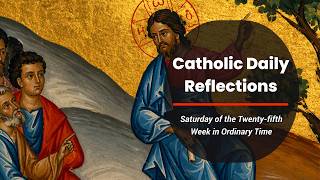
While they were all amazed at his every deed, Jesus said to his disciples, “Pay attention to what I am telling you. The Son of Man is to be handed over to men.” But they did not understand this saying; its meaning was hidden from them so that they should not understand it, and they were afraid to ask him about this saying. Luke 9:43b–45
After Jesus revealed His coming Passion, Death, and Resurrection to the Twelve for the first time, eight days passed. Then He took Peter, James, and John up a high mountain, where He was transfigured before them. That extraordinary glimpse of His divine glory may well have been a source of consolation, dispelling some of the sorrow and confusion they had carried since hearing the unsettling news that their Master would suffer and die.
Upon descending the mountain, Jesus and the three Apostles rejoined the remaining disciples and were met by a large crowd. A man in the crowd presented Jesus with his son who was possessed by a demon.
Jesus delivered the boy, and in response, “all were astonished by the majesty of God” (Luke 9:43a). It is immediately in this context of public amazement and admiration that Jesus once again turns to His disciples and predicts His Passion for the second time, as we read in today’s Gospel.
Jesus’ first prediction, recorded earlier in Luke 9, comes across as more reserved and instructional. But in this second pronouncement, there is a new tone that is more urgent and emphatic: “Pay attention to what I am telling you…” His words carry weight, demanding serious reflection. And yet, despite His directness and solemnity, the Gospel tells us: “they did not understand this saying; its meaning was hidden from them so that they should not understand it…” Even more, they were afraid to question Him.
Why was the meaning hidden from them? The answer lies in the mystery of what theologians call “divine pedagogy.” God often reveals His truths gradually, preparing the soul to receive what it cannot yet bear. The Passion of Christ is not only a historical event but a spiritual reality that we must accept with faith. Without the light of the Cross and Resurrection, the notion of a suffering Messiah remained incomprehensible to the Apostles. God permitted the veil over their understanding not as a punishment, but as a protection lest they fall into despair or distortion of the truth. Only after the Resurrection and Pentecost would their hearts be fully opened to grasp the necessity and glory of Christ’s suffering.
In our own journey of faith, we too encounter truths that seem hidden or are difficult to grasp. We may wonder why God allows confusion, trials, or periods of spiritual obscurity. When that happens, we can learn much from Jesus’ interaction with the Twelve in this passage.
Reflect today on these hidden moments in your own life. Are there aspects of God’s will you do not yet understand? Are there things that fill you with fear and tempt you to despair? Do not be afraid to approach Jesus with your questions, even if answers do not come immediately. Trust that in His perfect time, all will be revealed and that the Cross always precedes the light of the Resurrection.
Most mysterious Lord, the truth of who You are and what You do in my life is beyond my comprehension. When I am confused by life’s circumstances, please fill me with confidence in You and trust in Your providence. I know that You know all things and that You will my good. May I trust You in the midst of confusion and press forward with humility, knowing that, in the end, everything will come to light and be made known. Jesus, I trust in You.
Source: mycatholic.life
Share: