
For Christ also suffered for sins once for all, the righteous for the unrighteous, in order to bring you to God. He was put to death in the flesh, but made alive in the spirit. (1 Peter 3:18)


News
Making Word of God at Home in Every Heart
Bible Fest Inaugurates New Biblical Catechesis at Deepagam
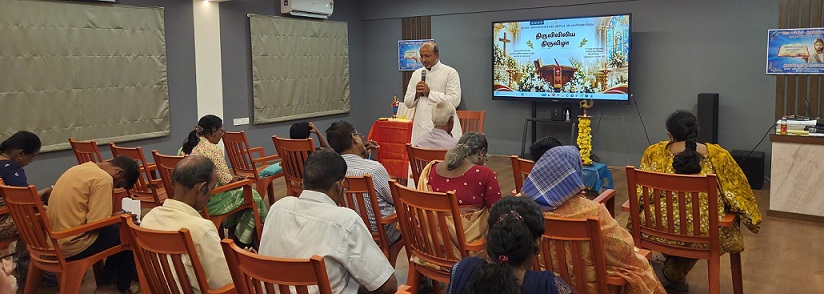
CHENNAI-KILPAUK SEPTEMBER 12, 2026: To mark Bible Month and inaugurate Biblical Catechesis, Deepagam, the Salesian Catechetical Centre of the Chennai Province, hosted a Bible Fest on September 12, 2026, at Deepagam Hall. Rev. Fr. John Richard, SDB, of Becchi-Don Bosco, Kavarapettai, delivered a keynote reflection on the Gospel of John to faithful from various Chennai parishes.
In his inaugural address, Fr. Jesudoss, who felicitated Fr. John Richard, appreciated Mr. Devaraj for his tireless effort in laity ministry and spreading the Word of God.
He said that biblical catechesis must become a “journey of experience—a journey of life.” All goodness comes from God—love, mercy, faith, and life. Jesus Christ is the evangelizer. Everything of Jesus is evangelization (his life, death and resurrection). But we aren’t yet fully living the gospel in India. The Christian message of the gospel and universal faith affirmation is, Jesus Christ is the Lord; Jesus is the Way, the Truth, and the Life.
Fr. Richard’s expounded summary of the keynote address on the topic: A Life Rooted in Love: St John's Vision of Christian Living:
God’s mercy is typified of a mother’s womb. ‘Yohanan’ in Hebrew means Yahweh has been merciful/gracious. The Gospel of John is all about how to love God. God revealed His name to Moses: “I Am Whom I Am." Jesus uses this “I am” throughout the Johannine gospel. Jesus, the Word became flesh and dwelt among us. In him, God lives with us. Taking the four gospels as one corpus, collectively we call them ‘good news.' In this sense, there aren’t ‘four authors’ of the good news.
‘God is eternal’ means He is transcended in time. God is without beginning and end. Everyone is God’s word, for everything is created through Word. We are people of light—born of light from God. ‘God is love; the Word is love. God’s love became flesh. Paul says, “In him we live, move, and have our being.”
In synoptics, evangelist Mark begins his gospel with Jesus’ public ministry leading to the passion narrative. Matthew and Luke begin the gospel with the infancy narrative. Whereas, John begins his gospel from the genesis (primordial sense).
The Gospel of John is written in simple Greek, easily understandable with in-depth meaning. Jesus does not use many parables in John’s gospel; Jesus talks in plain language. We need to have the heart and mind of the child to understand the divine mysteries. With pride and prejudices and the I-know-everything attitude, we can’t recognize Jesus. Jesus is portrayed as a disciple of John the Baptist in the gospel.
Jesus is loved by God, and he speaks the love of God. Only ‘the loved’ can speak about 'love.' For love sets us on fire. We are actually celebrating God’s love in marriage feasts.
In Wedding at Cana, Mary says, “Do whatever he tells you.” Jesus said, "Love one another." The Gospel of John is a book of (seven) signs; it tells us, "I am what I am—love."
With Nicodemus, Jesus is not talking about love but about doing love. The boundless love on the cross is manifested when blood and water flowed from the side of Jesus on the Calvary. There, God gives a second birth of spiritual creation. In fact, God has crucified himself right at the time of creation.
First word by Jesus in the Gospel: “What do you want?” The disciple asks Jesus, “Where are you staying?” Jesus replies, “Come and see.” And disciples stay with Jesus and become the followers of Christ. At the Last Supper, the beloved disciple is reclining at Jesus’ breast.
Adam was a holistic person before becoming man. Creation is the separation of darkness and light, man and woman.
In Farewell Discourse (Gospel of John, chapter 13), Jesus makes himself a slave for others in the Eucharist. He uses the sign, Vine and Branches to express his communion with believers. In Greek the term used is ‘abide in my love.' Spirit reveals God’s Trinitarian love. Only a loving disciple can be like a mother. We see in chapter 19 that no human has lasting love. Peter denied love while denying Jesus. That’s why in the post-resurrection narrative, Jesus asks Peter, “Do you love me?”
We need to experience Jesus’ love as our Good Shepherd (chapter 10). We must taste his love. For love in itself is not bitter, but loving others can be very bitter. Let us be like children in human articulations. Truth is simple, plain, and straightforward. Only, evil is complicated, and the easiest thing is the most plain and simple.
Mrs. Pauline Rose (Deepagam Coordinator) introduced the new YouTube devotional song produced by Deepagam, Puthiyathor Paadal - Thirupaadal 150, which was released by Br. Yovan (Becchi-Don Bosco, Kavarapettai). Mrs. Pauline explained this new Deepagam’s venture of producing visual songs and making it available on the Social Media (YouTube) to reach out to the today’s youth and digital natives.
While giving the vote of thanks, Mr. Devaraj (Deepagam Collaborator) reiterated the gospel values of Illam Thedi Irai Arasu: love, truth, equality, and justice. He said that we need to reach out to the people of faith, for which we need to learn the gospels in depth. He suggested forming Bible study groups and drawing action plans to discuss with the study group. He expressed his concern that ‘there is a strong change of orientation today.’ And reminded the participants to create a civilization of love in the spirit of Holy Father’s latest encyclical—Magnifica Humanitas.
An online evangelist Mr. Navarajan S. of anbinmadal.org was felicitated for his 25 years of contribution to the Catholic Church. The event concluded with Deepagam’s YouTube song on Marian Devotion: Annaiyum Neeye Anaithum Neeye.