
“Be still, and know that I am God! I am exalted among the nations, I am exalted in the earth.†(Psalm 46:10)


News
The Parish Catechism Teachers and Deepagam Lay Activists has formatively attended to Pope Leo XIV’s Encyclical Magnifica Humanitas
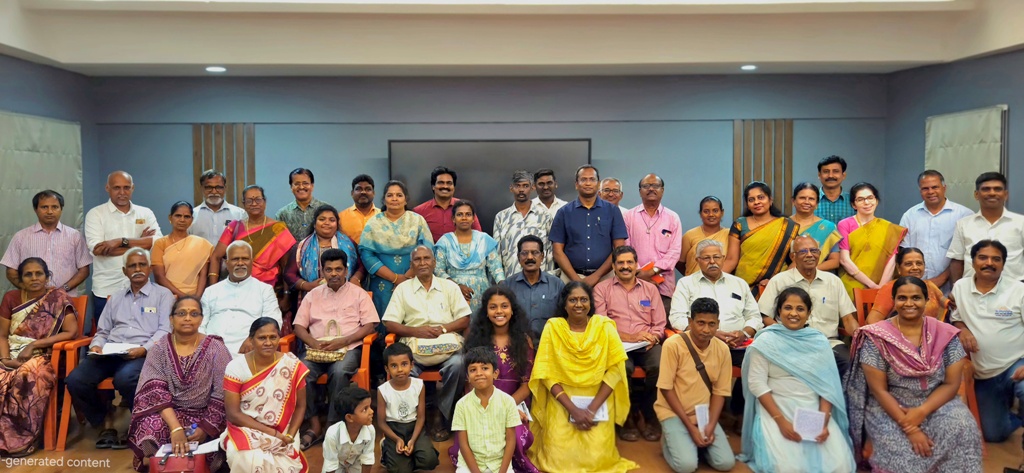
Kilpauk-Chennai, August 02, 2026: Deepagam Don Bosco Catechetical Center has organized one-day workshop for Sunday Catechism Teachers and a Seminar on Magnifica Humanitas on August 2, 2026 10:30 AM to 5:00 PM at Kilpauk, Chennai through in-person get together and online coverage of the event. The purpose of the workshop and seminar was catechetical dissemination of the first encyclical by Pope Leo XIV, Magnifica Humanitas.
The topics of the day were: Salesian Accompaniment, Methodologies for Conducting Catechism Class, Characteristics of a Catechism Teacher, and formative discussion on Pope Leo XIV's first encyclical - Magnifica Humanitas. Total number of participants (in and around Chennai) were forty comprising of young people and Sunday catechism teacher and Deepagam collaborators.
The day begun with Bro. Maria Yovan (DBTC, Kavarapettai) leading the community in prayer with hymn to Holy Spirit and reading from gospel (Mt 25:14-30 - Parable of Talents), followed by Lighting of the Lamp. In his welcome address, Fr. Jesudoss said, “Don Bosco began Catechetical ministry from his childhood days”. He also reminded that Catechism is first and foremost pastoral responsibility for every Salesians.
Rev. Bro. Arunraj (Rector, The Citadel, Kilpauk-Chennai) begun his inaugural address saying, “We are all here in the name of Jesus”. He too reiterated the important pastoral responsibility of Salesian as engaging in formative-instruction on Catechism. He concluded saying “we need to create transformation in the life of our catechism children.”
Mrs. Pauline Rose who organized the Sunday Catechism Teachers workshop shared typical catechetical session for children: Opening Prayer, Attendance, Recap of Past Lesson, Today’s Lesson, Word of God (through dance and/or song), Today’s Saints, Today’s mass Readings, News and Events (Parish, Diocese, Church) and Final Prayer (use of children’s memory skill and illustrating messages with practical examples); prayer is used as preparatory method for catechetical instruction. Four groups of workshop participants were formed to discuss on themes and the group sharing were presented by the representative in synodal way.
We began the afternoon seminar on Magnifica Humanitas with hymn: Sakthi Aanavaa Jeeva Naayagaa (vocalized by Mrs. Vimala Albert; Readings from Revelation (21:1-8) and excerpts of Magnifica Humanitas highlighting the dangers to human society in AI Era” were read.
Mrs. Pauline Rose explaining Chapter one, quoting the Encyclical said, “Gospel can’t be separated from human life and Church can’t be differentiated from human history.”
Mr. Maria Michael who introduced the chapter two, commented that encyclical must be read from social teachings of the Church and stressed on the human dignity from the context of divine act of creation. Humanity is created in the image of God with dignity and has inherent right to life. He said that the chapter two highlights the Common Good, Community Responsibility and Social Justice. He called on the participants to be responsible, accountable, and transparent and not misuse the authority.
Technology and its domination were the highlights (as found in chapter three) of the presentation by Mrs. Vimala who pointed out the gross inequalities in the corporate world and the various manifestations of addiction to Smartphones in today’s society and culture.
Transhumanism and Posthumanism are the two important contemporary errors conversed in chapter four as noted by Mr. Valan Dharsis. He underlined the specter of ‘deskilling’ and unemployment in economic society, all driven by AI and subversion of human values in market economy. He unraveled how AI was used by Cockroach Janta Party (CJP) to run political campaign by few activists, initially. He also pointed out that the new forms of slavery are emerging in the current social conditions through the use and abuse of AI.
Fr. Jesudoss P. SDB, who presented the fifth chapter of the Encyclical told: ‘in digital era, Christians must reject all forms of Power-Consciousness, Violence and Hatred.’ Instead, must create civilization of love, justice, dialogue and peace. “The alternative pathways of peace are justice, digital asceticism, and culture of encounter”, Fr. Jesudoss said. We need to transcend all forms of discriminations such as, caste, class and religions; human dignity must be the priority. As case study, he conscientized how class and caste barriers are still existing even in death (i.e. cemetery burials).
Fr. John Christy (former YMD) while introducing Fr. Stalin Dhanaraj, SDB (Youth Ministry Delegate) said, “I became what I am because of our catechist from Perambur.” He joked about the church bell that invites all for prayer while remaining standing at the church entrance. He remarked, “Children creates us (or, forms us) - hence let us pay attention to them.”
Fr. Stalin began his expository address saying, “Whenever social building-blocks are destroyed, challenges take place in the Church”. For example, the case of ‘one-man ruled by another man’ and ‘one man becoming slave to another for profit’. Further, quoting Holy Father, he said, “We are not in era of changes; but change of an era.”
The Magnifica Humanitas must be read from the background of Rerum Novarum (1891). Then was Industrial Revolution. Now is the time of Artificial Intelligence. He cautioned that AI will become automatic entity (i.e. sentient). The Encyclical is not defining spiritual doctrine, but it is an extension of social doctrine. The leading IT firms namely, Microsoft, Google, Meta and Anthropic has taken different stand vis-à-vis the encyclical, which offers us five principles namely, 1) Common Good vs Private Good, 2) Unity/Communion vs Divisiveness, 3) Subsidiarity, 4) Universal Destination of Goods and 5) Social Justice.
Mr. Deveraj (Deepagam Collaborator) as the program coordinator, who organized the Seminar on the Encyclical concluded it reminding everyone that Sacred Scripture and Patristic Tradition are two important pillars of the Church. He appealed all to heed attentively to the voice of the Church spoken through the history, and in our time especially through Magnifica Humanitas (MH2026).